
How Smart Systems Are Changing Productivity, Decision-Making & Growth in 2026
The future of AI in business automation is no longer something to wait for – it is already here. Today, Artificial Intelligence is helping companies of every size cut costs, speed up workflows, and make better decisions. AI now powers everything from email sorting and invoice processing to demand prediction. It has become the core engine of modern business. In this article, we cover the key trends and real-world use cases. We also share the steps your business needs to stay ahead in 2026.
What Is AI-Driven Business Automation?
AI-driven business automation uses smart tools like Machine Learning (ML), Natural Language Processing (NLP), AI agents, and Predictive Analytics to run, improve, and manage business tasks with very little human input.
Unlike traditional automation which simply follows fixed rules AI systems can learn from data, adjust to new situations, and make context-aware decisions on their own. As a result, businesses get far more value than they would from basic rule-based tools.
Why AI Automation Is Shaping the Future of AI in Business Automation
Businesses face constant pressure to cut costs and move faster. They also need to serve customers better and grow without large teams. However, doing all of this manually is no longer practical. This is exactly why AI automation has become the go-to answer — it handles all of these challenges at the same time.
According to a 2026 Deloitte survey of over 3,200 global leaders, the number of companies with 40% or more AI projects in production is expected to double within six months. Clearly, AI has moved well past the testing stage and into real-world use at scale.
Key Trends Shaping AI Business Automation in 2026
1. The Rise of Agentic AI and Intelligent AI Agents
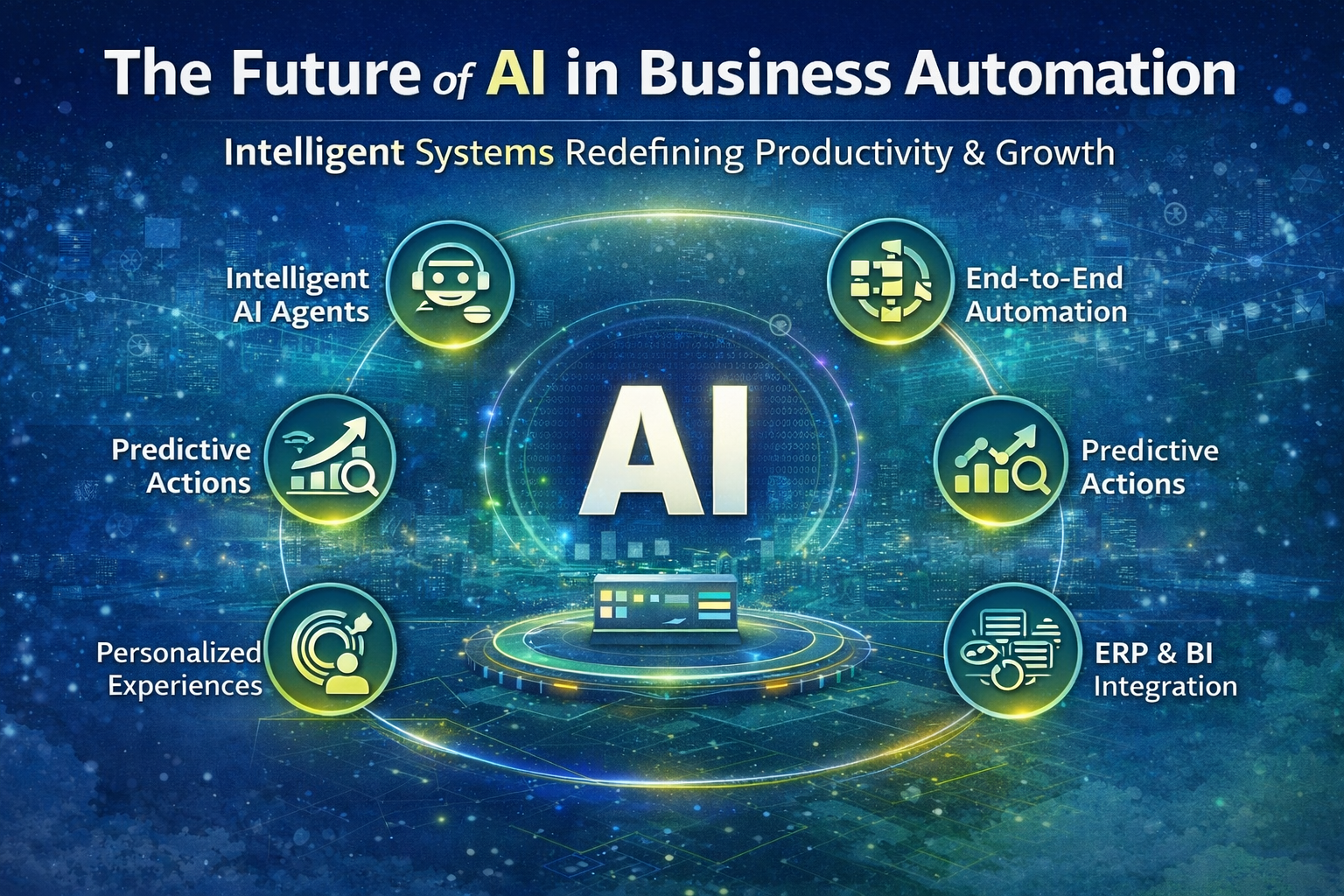
One of the biggest shifts in 2026 is the rise of agentic AI – AI systems that can act on their own to complete tasks. These AI agents go far beyond basic chatbots. They can handle customer queries, process documents, trigger workflows, and connect with multiple systems. Moreover, they work around the clock and keep getting better through learning. As a result, companies using AI agents report faster response times and lower support costs.
2. End-to-End Workflow Automation
The future is not about automating one small task here and there. Instead, the focus has shifted to end-to-end workflow automation – connecting entire business processes from start to finish.
For example, a sales pipeline can now flow smoothly from Lead → CRM → Quotation → Invoice → Payment without manual handoffs. Similarly, procurement processes like Purchase Request → Approval → Order → GRN → Accounting can be fully automated. Because of this, workflows become faster, error-free, and fully traceable.
3. Predictive and Action-Recommending Automation
AI is moving beyond just reporting what happened in the past. Now, it can predict what is likely to happen next and even recommend the best action to take. For instance, businesses are already using AI for demand forecasting, stock-level planning, cash-flow prediction, and fraud detection. In other words, companies can act before problems happen, not after.
4. AI + ERP + BI Coming Together
AI is now being built into ERP and analytics platforms. For example, tools like SAP Business One implementations and CRM and ERP ecosystems are adding AI features for real-time insights, automated decision-making, and smart alerts.
As a result, business leaders no longer need to wait for weekly reports – they get live, AI-powered recommendations that help them act immediately.
5. Highly Personal Customer Experiences
AI automation is also making every customer interaction smarter. Specifically, it powers personal marketing messages, dynamic pricing, smart product suggestions, and AI-driven customer support. Because every interaction is driven by real data, customers feel understood – which leads to higher satisfaction and repeat business.
6. Low-Code and No-Code AI Platforms
Perhaps the most exciting trend is that AI automation is becoming easy to use for everyone. Low-code and no-code AI platforms have changed the game. Businesses can now build automated workflows without relying heavily on developers. As a result, this opens up automation to teams across the entire company – not just the IT department.
7. AI Governance and Responsible Use
Finally, as AI takes on more tasks, the need for proper oversight is growing. Frameworks like the NIST AI Risk Management Framework and OECD’s AI policy guidelines are helping businesses build AI systems that are fair, transparent, and secure. In other words, strong AI governance is quickly becoming a must-have – not a nice-to-have.
Real-World Business Use Cases
| Business Function | AI Automation Impact |
|---|---|
| Finance | Invoice processing, bank matching, and cash-flow forecasting |
| Sales | Lead scoring, automated follow-ups, and deal prediction |
| HR | Resume screening, onboarding workflows, and attendance tracking |
| Operations | Stock planning, quality checks, and supply chain alerts |
| Customer Support | AI chat agents, voice agents, and ticket sorting |
Benefits of AI in Business Automation
When done right, AI automation delivers clear and measurable results. First, it cuts down on manual, repetitive tasks. Second, it speeds up decision-making by surfacing the right data at the right time. Third, it improves accuracy and helps companies stay compliant with rules and standards. Additionally, it allows operations to grow without adding headcount. Above all, it leads to happier customers who receive faster, better service.
How Businesses Should Get Ready for the AI-Driven Future
If you want to stay competitive, here are the steps to take:
- Start with processes that are ready for automation. For example, repetitive tasks like data entry, invoice matching, and email responses are great starting points.
- Invest in clean, well-structured data. AI is only as good as the data you feed it. Therefore, cleaning up your databases is the single most important step.
- Connect AI with your existing systems. Rather than replacing everything, build AI on top of tools you already use like your ERP, CRM, or BI dashboards.
- Train your team to work alongside AI. After all, AI doesn’t replace people it makes them more effective. Invest in skills that add real value rather than fearing change.
- Pick future-ready, scalable solutions. In particular, choose tools and partners that grow with your business needs.
Conclusion: The Future of AI in Business Automation Starts Now
The businesses that thrive in 2026 won’t be the ones still debating whether to use AI. Instead, they’ll be the ones that have already woven AI into their daily workflows from sales and finance to customer support and supply chain.
Whether you are a growing startup or an established enterprise, the time to act is now. At NexIndia Tech, we help businesses turn AI from a buzzword into real, measurable results. As your digital transformation partner, we combine deep technical expertise with practical business understanding to make your AI in business automation journey smooth and successful.