
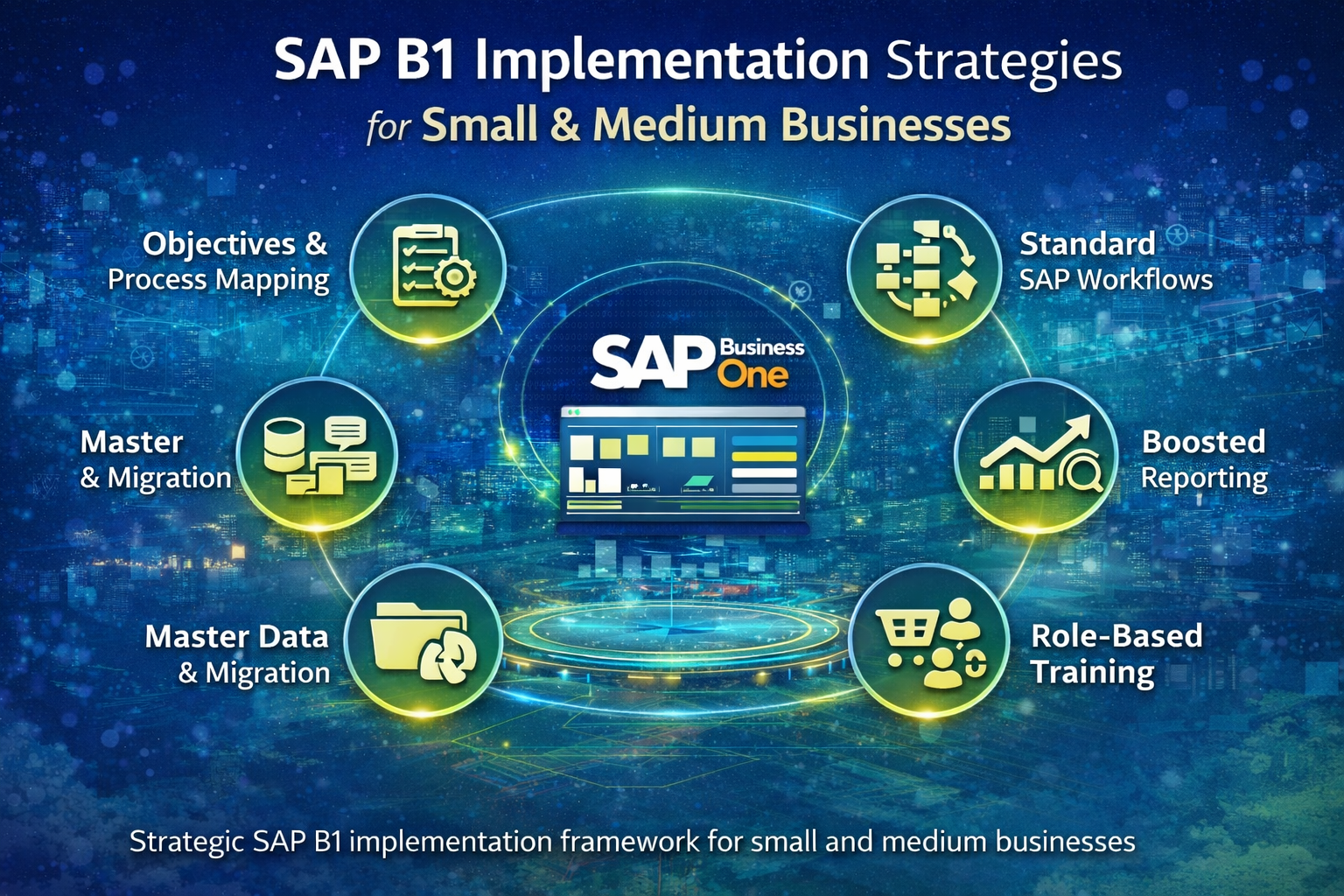
Choosing the right SAP B1 implementation strategies is the most important step for any SME adopting ERP. SAP Business One (SAP B1) is a powerful ERP for Small & Medium Businesses (SMBs/SMEs). It helps companies streamline operations, gain real-time visibility, and scale efficiently. However, success depends less on the software itself and more on how it is planned and rolled out. This guide provides a practical, step-by-step approach to SAP B1 implementation strategies tailored for SMEs.
Why SAP B1 Implementation Strategies Matters for SMEs
SMEs often struggle with tight budgets, manual processes, and systems that don’t talk to each other. At the same time, rapid growth creates pressure to upgrade but without a clear plan, ERP projects can stall or fail. This is exactly why a structured implementation strategy is so important. With the right approach, SMEs can expect faster go-live timelines, higher ROI from day one, lower risk and rework, and much better user adoption across teams.
1. Define Clear Business Objectives First
Before any technical work begins, start with why you are implementing SAP B1. Ask yourself: What problems are we solving? Which processes need automation first? What KPIs will define success — such as cash flow, inventory turns, or profit margins?
For example, a manufacturing company might focus on stock accuracy, while a services firm might prioritise billing speed. Knowing your goal shapes every decision that follows. Additionally, if your business follows a value their worth pricing strategy, aligning your ERP with your pricing model is critical.
Strategy Tip: To avoid scope creep, limit phase 1 scope to core operations. Expand after stabilization.
2. Perform Detailed Process Mapping
Next, document your current (AS-IS) and future (TO-BE) processes. Specifically, focus on sales to invoicing, purchasing to payments, inventory movements, and financial closing workflows.
As a result of this exercise, you get a clear picture of where SAP B1’s standard features already fit your needs and where minor adjustments may be required.
3. Adopt SAP Standard Processes in Your SAP B1 Implementation Strategies
SAP Business One includes proven workflows that work well for most SME situations. For instance, the standard sales flow runs from Sales Order → Delivery → A/R Invoice. Similarly, purchasing follows Purchase Order → GRPO → A/P Invoice.
Because these standard processes are already tested and optimised, sticking with them means faster setup, easier upgrades, and lower long-term maintenance costs. Therefore, customise only where it adds genuine business value.
4. Prepare Clean and Structured Master Data
Poor data leads to poor ERP outcomes this is one of the most common reasons implementations go wrong. Before migrating anything, make sure your master data is clean and well-organised. This includes your Chart of Accounts, item master records, business partner lists, tax codes, and price lists.
Best Practice: Always finalise naming conventions and data standards before starting the migration process.
5. Plan Data Migration as Part of Your SAP B1 Implementation Strategies
Data migration is not a simple copy-paste activity. Instead, it requires careful planning to avoid carrying over errors from your old system. Typically, you should migrate opening balances, active customers and vendors, current inventory, and open transactions only.
Strategy Tip: Most importantly, clean your legacy data thoroughly before loading it into SAP B1. Dirty data in a new system simply creates new problems faster.
6. Set Up Authorisations and Approvals Early
Even small businesses need proper controls. SAP B1 offers built-in tools for approval procedures, role-based access, and audit trails. By setting these up early, you ensure compliance without slowing down daily work.
Moreover, as data security becomes increasingly important in 2026, frameworks like the NIST cybersecurity framework can guide your access control policies.
7. Enable Reporting and Analytics from Day One
One common mistake is postponing reporting setup until after go-live. However, the whole point of ERP is better visibility so reporting should be ready on day one.
At a minimum, set up Profit & Loss, cash flow, inventory aging, and AR/AP aging reports. For deeper insights, enhance SAP B1 with Crystal Reports or Power BI dashboards. You can also explore AI-driven business automation tools to make your analytics even smarter.
Result: Faster, data-driven decisions from the very first week.
8. Integrate SAP B1 with Business Ecosystem - A Key SAP B1 Implementation Strategies Step
Automation multiplies the value of SAP B1. For example, common integrations for Indian SMEs include GST and E-Invoicing, banking and payment gateways, WhatsApp or SMS alerts, e-commerce platforms, and BI tools.
When you connect SAP B1 with your wider CRM and ERP ecosystem, manual data entry drops and accuracy goes up. As a result, your team spends less time on repetitive tasks and more time on work that matters.
To learn more about what SAP Business One offers out of the box, visit the official SAP Business One product page.
9. Conduct Role-Based User Training
Rather than running generic training sessions for the whole company, focus on role-based learning. Specifically, train your finance team on accounting, banking, and reports. Train your sales team on orders and invoicing. Train your stores team on inventory and GRPO.
Because each team only learns what they actually use, adoption happens faster and confidence grows quickly.
10. Go-Live with Support, Monitoring, and a Plan for Phase 2
During go-live, keep your core team available, monitor every transaction daily, and resolve issues immediately. After the system is stable, plan your Phase 2 enhancements, review KPIs against your original goals, and optimise workflows based on real usage data.
In short, go-live is not the finish line it’s the starting point of continuous improvement.
Final Thoughts on SAP B1 Implementation Strategies
A successful SAP B1 project is not just a technical upgrade it’s a full business transformation. With the right SAP B1 implementation strategies, SMEs can achieve operational efficiency, financial transparency, process automation, and scalable digital growth.
Looking ahead, SAP has confirmed a strong roadmap for Business One with a web client built on SAP Fiori, cloud-first deployment options, and a version 11 release planned for 2027. In other words, investing in SAP B1 today is a future-proof decision.
At NexIndia Tech, we bring hands-on experience as a digital transformation partner helping SMEs implement SAP B1 with clarity, discipline, and confidence. If you’re ready to begin your SAP B1 implementation journey, let’s talk.