
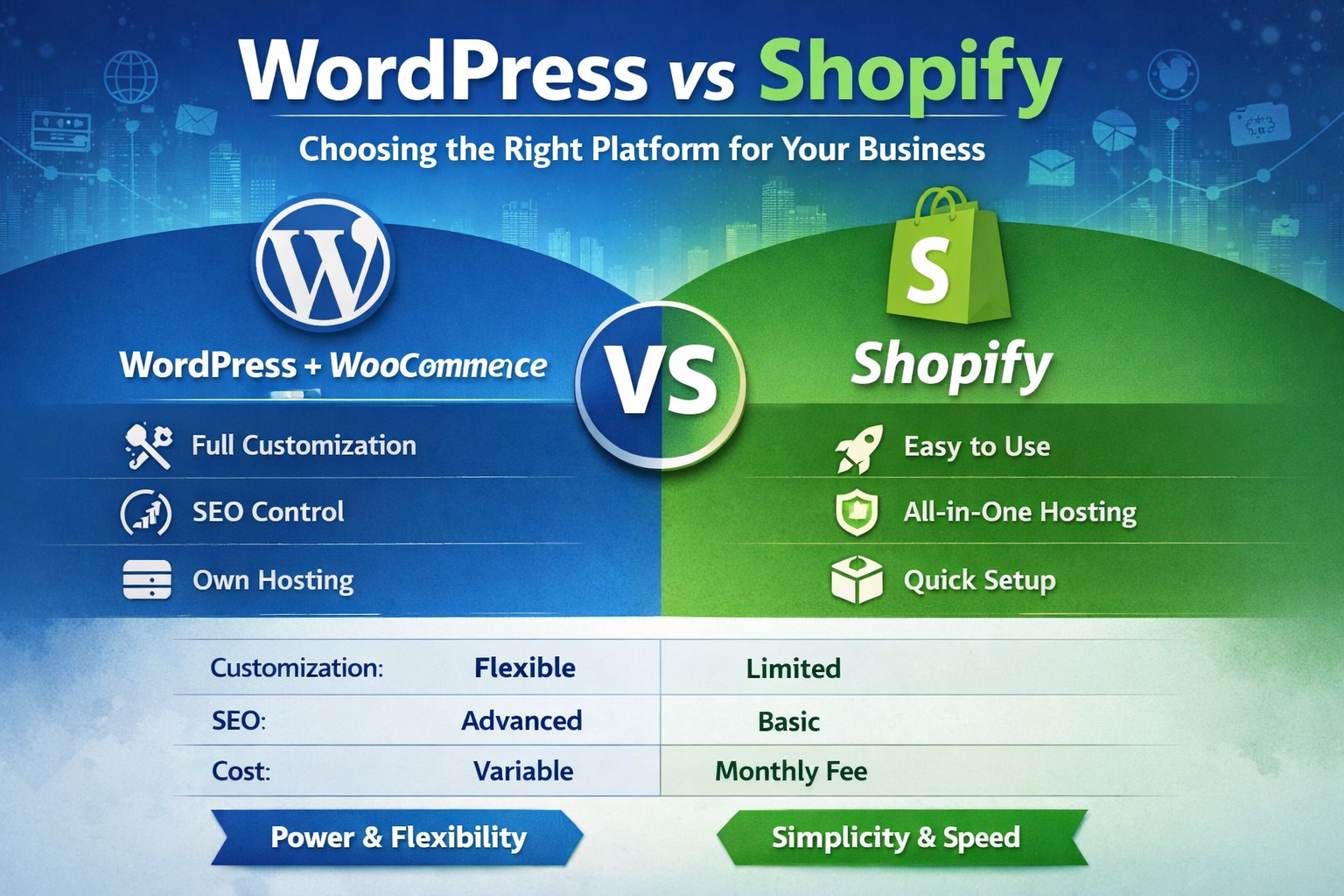
The WordPress vs Shopify debate is one of the most common questions for any business planning to sell online in 2026. Both platforms are powerful, widely used, and SEO-friendly. However, they serve very different business needs. In this guide, we break down the key differences to help you make the right choice.
What Is WordPress (WooCommerce)?
WordPress is a free, open-source content management system (CMS). When combined with WooCommerce, it becomes a highly flexible eCommerce solution. Because you host it yourself, you get full control over your website’s design, data, and performance.
Key Strengths of WordPress
- Full control over design, data, and hosting.
- Unlimited customisation with themes and plugins.
- Excellent SEO capabilities for ranking higher on Google.
- Ideal for content-heavy websites and blogs.
- Scales well for custom workflows and integrations.
Best For
WordPress works best for businesses that need custom features and deep SEO control. For example, agencies, service providers, and growing brands often choose WordPress. Additionally, companies focused on content marketing find it ideal. If your business uses tools like a CRM and ERP ecosystem or AI-driven business automation, WordPress integrates smoothly with these systems.
What Is Shopify?
Shopify is a fully hosted eCommerce platform built for speed and simplicity. Unlike WordPress, Shopify handles all the hosting, security, and maintenance for you. As a result, you can launch a store quickly without technical expertise.
Key Strengths of Shopify
- Quick and easy store setup in minutes.
- Secure, managed hosting included in every plan.
- Built-in payment gateway and checkout.
- Minimal technical maintenance required.
- Reliable performance for standard online stores.
Best For
Shopify is a great fit for small to medium online stores. Specifically, it suits entrepreneurs with limited technical resources. Moreover, businesses focused on dropshipping or product-only stores find Shopify the fastest way to start selling.
WordPress vs Shopify: Feature Comparison
| Feature | WordPress (WooCommerce) | Shopify |
|---|---|---|
| Ease of Use | Moderate – needs some learning. | Very easy – beginner-friendly. |
| Customisation | Unlimited – full code access. | Limited – theme-based. |
| SEO Control | Advanced – deep optimisation. | Good – covers the basics. |
| Content Marketing | Excellent – built for blogging. | Basic – limited blog features. |
| Ownership | Full – you own everything. | Platform-dependent. |
| Scalability | High – grows with your needs. | Medium – may hit limits. |
| Monthly Cost | Flexible – you choose hosting. | Fixed subscription plans. |
| Integrations | Extensive – thousands of plugins. | App-based – via Shopify store. |
Which Should You Choose? A WordPress vs Shopify Decision Guide
The right choice depends on your business goals. Here is a simple way to decide:
If you need deep customisation, strong SEO, and long-term scalability choose WordPress. On the other hand, if you want a fast, hassle-free store launch with minimal technical work choose Shopify.
For businesses running complex operations such as those using SAP B1 implementation strategies or multi-channel sales WordPress with WooCommerce offers better flexibility. However, if your main goal is to sell a few products quickly, Shopify gets you there faster.
Ultimately, both platforms can succeed. The key is matching the platform to your specific needs.
Final Thoughts on WordPress vs Shopify
The WordPress vs Shopify decision is not about which platform is “better.” Instead, it is about which one fits your business goals, budget, and growth plans. Before choosing, ask yourself: Do I need full control? Or do I want managed simplicity?
At NexIndia Tech, we help businesses pick the right platform and build it properly. As your digital transformation partner, we handle everything from design and development to SEO and ongoing support. If you’re ready to launch or migrate your online store, let’s talk.